
Manufacturing
How a Housecab cable is made, from raw material inspection to the drum it ships on.
Process Flow
Ten stages, from raw material procurement to the drum it ships on. Steps 9 and 10 sit under Quality Control on the live site even though they are manufacturing steps.
Raw material procurement
- We source conductors (copper, aluminium), insulation materials (PVC, XLPE) and jacketing materials (PVC, nylon) from approved vendors with documented quality control procedures.
- Every delivery is inspected on arrival against its material specification and certification.
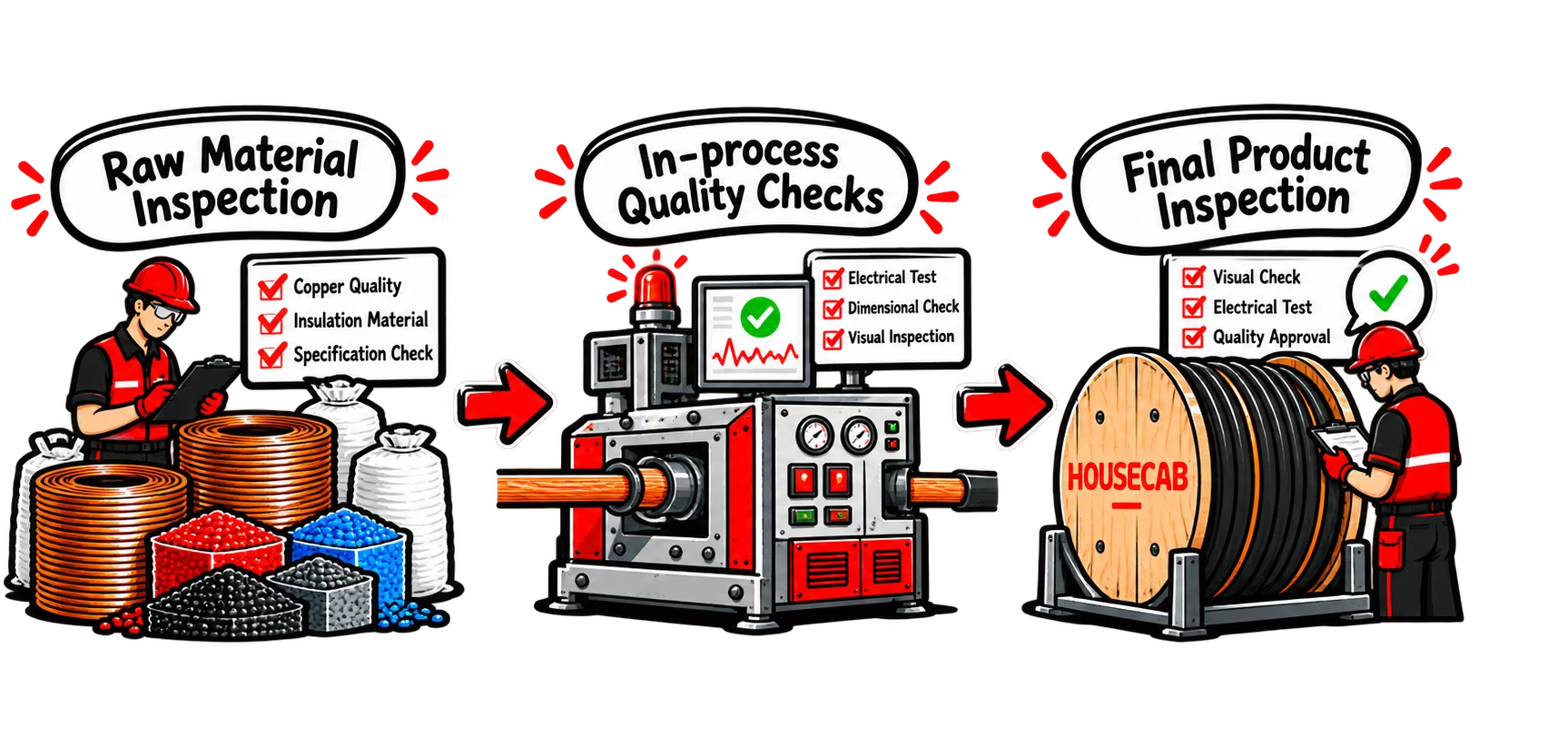
Raw material inspection
- All incoming materials are meticulously tested to ensure they meet our stringent specifications.
- We source materials only from trusted suppliers who adhere to global quality standards.
Design and engineering
- Our engineers use design software to draw up cable specifications from customer requirements and the applicable industry standards.
- Voltage rating, current-carrying capacity, operating temperature and environmental conditions all feed into the design.
Conductor preparation
- Depending on the cable, conductors are annealed to soften them or drawn down to reduce diameter until they reach the properties the design calls for.
- We hold conductor size, cleanliness and freedom from defects under strict quality control at this stage.
Insulation
- Insulation and jacketing are applied to the conductor on extrusion lines.
- We control temperature, pressure and extrusion speed precisely, so application is uniform and thickness stays consistent.
- In-line inspection, automated and visual, catches flaws in the insulation or sheath as they happen.
Cabling and stranding
- For multi-conductor cables, individual insulated conductors are twisted together to form a core.
- Lay length — the twist pitch — is controlled precisely, because it governs flexibility, electrical performance and signal integrity.
Outer sheathing
- We apply the final outer jacket, which protects the cable from mechanical damage, environmental exposure and UV radiation.
Quality control
- Throughout the manufacturing process, we conduct continuous monitoring to identify and address any deviations.
- Automated testing equipment ensures consistency and precision in extrusion, braiding and insulation processes.
Printing and labelling
- We print the manufacturer's name, cable type, voltage rating and size onto the cable jacket.
- Printing is clear and durable, and follows both industry standards and customer specifications.
Coiling and packaging
- Finished cable is spooled or reeled onto drums of appropriate size and strength.
- We package with protective materials so the cable is not damaged in storage or transit.
Quality Control
What we check, and when.
Advanced testing facilities
Our testing labs are equipped to perform electrical, mechanical and environmental tests. Tests include:
- Dielectric strength testing
- Ensures insulation integrity under high voltage.
- Tensile strength testing
- Verifies the mechanical durability of the cables.
- Flame retardant testing
- Confirms compliance with fire safety standards.
Warehousing and Distribution
- Finished cables are stored in a controlled environment that maintains material integrity and prevents deterioration.
- Our distribution system is built to get cables to customers promptly and safely.
Continuous Improvement
Housecab Solution Private Limited works continuously on its manufacturing processes. We are:
- Investing in technological advancement — automation, robotics and real-time process monitoring.
- Reviewing and updating quality control procedures regularly to identify and address potential issues.
- Conducting research and development into new materials and innovative cable designs.
- Running employee training programmes to keep a skilled and knowledgeable workforce.
Get a quotation
Request a factory visit
See the plant, the testing lab and the process for yourself. Tell us when suits and we will arrange it.